PHOTOPERIOD 1 enhances stress resistance and energy metabolism to promote spike fertility in barley under high ambient temperatures
Abstract
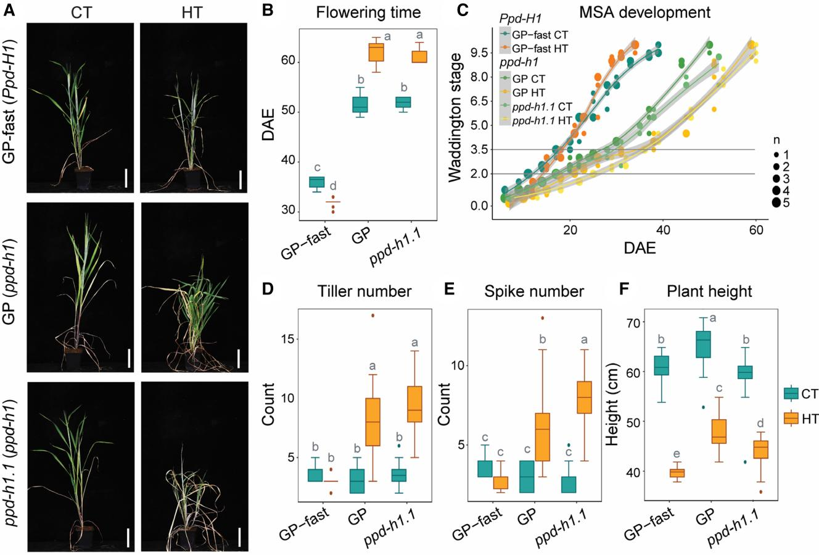
High temperature (HT) impairs reproductive development and reduces grain yield in temperate crops. This study demonstrates that PHOTOPERIOD 1 (PPD-H1), a barley homolog of Arabidopsis circadian clock pseudo-response regulators, confers developmental stability under HT by enhancing stress resistance and maintaining energy metabolism. Using near-isogenic lines (NILs) carrying either the ancestral wild-type *Ppd-H1* allele or natural *ppd-h1* mutations (selected to delay flowering and improve yield under favorable conditions), we showed that HT delayed inflorescence development and reduced grain number in *ppd-h1* mutants, while wild-type *Ppd-H1* genotypes exhibited accelerated reproductive development and stable grain number under HT. CRISPR/Cas9-mediated genome editing revealed that the CCT domain of PPD-H1 controls developmental stability independently of clock gene expression. Transcriptome and phytohormone analyses showed increased stress-responsive gene expression and elevated abscisic acid (ABA) levels in leaves and inflorescences of both natural and induced *ppd-h1* mutants. Furthermore, *ppd-h1* lines displayed downregulation of genes involved in photosynthesis and energy metabolism, along with reduced auxin and cytokinin levels in inflorescences, which impaired pollen and anther development. In contrast, wild-type *Ppd-H1* plants maintained stable transcriptomes, phytohormone levels, and anther/pollen development under HT. Our findings indicate that PPD-H1 enhances stress resilience and energy metabolism, thereby stabilizing reproductive development, inflorescence fertility, and grain formation under high temperature.