An elegant co-transformation strategy for recalcitrant wheat using morphogenic regulators
Abstract
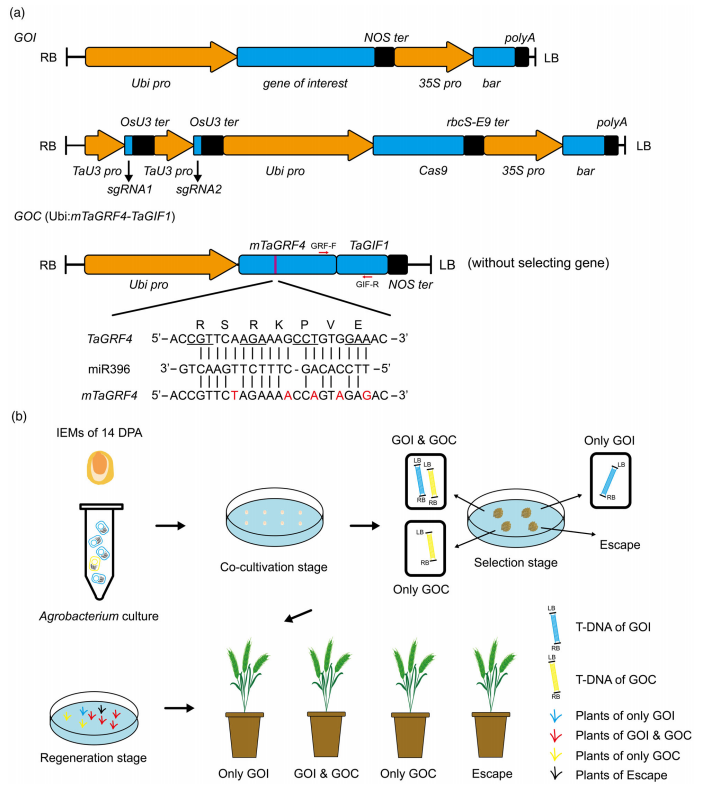
Common wheat (Triticum aestivum L.) is a vital global crop, but many elite cultivars remain recalcitrant to genetic transformation, hindering functional genomics and crop improvement. Here, we developed an efficient co-transformation strategy for recalcitrant wheat varieties (e.g., Aikang58 and Xinong979) using the morphogenic gene mTaGRF4-TaGIF1. This approach entails mixing Agrobacterium tumefaciens cultures carrying two separate vectors: a standard gene-of-interest (GOI) vector (containing a selectable marker) and a gene-of-co-transformation vector (GOC, expressing mTaGRF4-TaGIF1 without a selectable marker). Co-transformation enhanced regeneration efficiency to ~37.38% in AK58, a marked improvement over conventional methods, enabling consistent recovery of transgenic plants. Among regenerants, ~63.25% carried both GOI and GOC (GOI&GOC), while ~11.92% contained only the GOI. Only-GOI plants could also be obtained through progeny segregation from GOI&GOC lines. We successfully generated GUS- and RUBY-expressing transgenic lines, as well as CRISPR-Cas9-edited mutants targeting Q and Ph1 genes, confirming the method’s efficacy for both gain-of-function and genome editing application. Furthermore, the strategy was successfully extended to another recalcitrant variety Xinong979, demonstrating its potential for broad applicability. Unlike existing methods dependent on complex excision systems or tissue-specific promoters, our co-transformation methodology significantly simplifies both vector design and procedural workflow while maintaining high efficiency. Collectively, these findings establish a technically advanced yet operationally simplified transformation platform that addresses the long-standing challenge of genetic transformation in recalcitrant wheat varieties, providing researchers with a powerful tool for functional genomics studies and accelerating precision breeding programs in elite wheat cultivars.